Too heavy
to hold alone.
Exceptional in-home care for families who want their time back. We manage the day—around the clock or live-in—so you can stop being a full-time caregiver and return to being family.
- Guilt.
- Obligation.
- Performance.
- Burnout.
You're not wrong to feel
any of it.
The people who feel it most are the ones doing the most. It doesn't mean you love them less. It means you've been holding a day that was never built for one person to hold.
A day, held
What actually happens in the house.
Every agency hands you a list of services. Nobody shows you the day.
Care plan note: This timeline represents a composite example. Every client's day is uniquely mapped to their specific needs and routines.
Morning
The first transfer of the day.
Getting out of bed is when most falls happen. Someone is there before his feet touch the floor — not to hover, but to be standing in the right place.
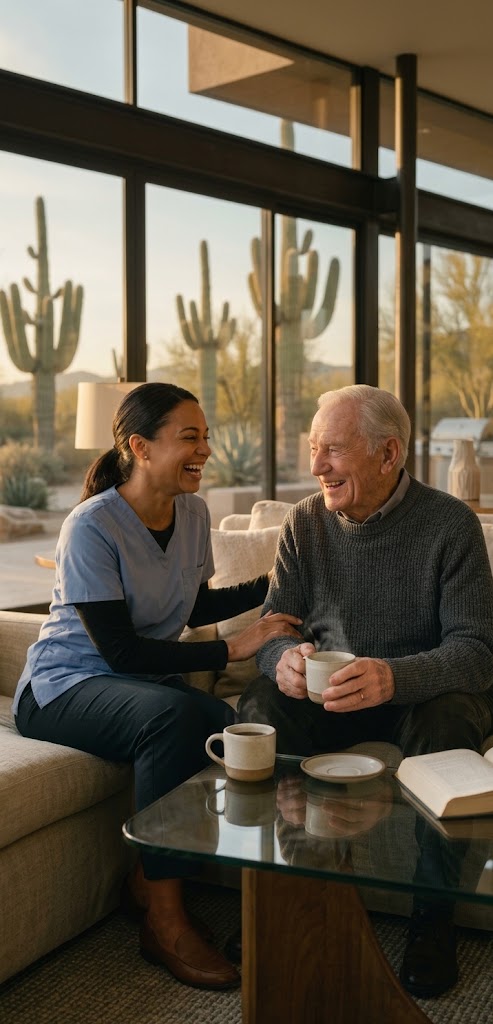
Coffee before the pills, because that's how he's taken them for forty years. Shower, dressed, in his own chair by seven. The morning stays his.
Our approach
“ We're not here to replace you.
We're here so that when you walk through the door on Sunday, you get to be his daughter again. Not his aide, his nurse, his scheduler, and his alarm clock.
Eight-hour minimum days.
Not quoted after a sales call.
them before day one.
mobility, companionship.
Our standards
We're new. So we'll show our work instead of our reviews.
EverHome opened this year. We don't have a wall of testimonials, and we're not going to borrow anyone else's. What we can do is tell you exactly what we require of the person who walks into your parent's house. Ask any agency in the Valley for this list in writing. It's a short conversation.
Fingerprint clearance
A valid Arizona Fingerprint Clearance Card before a first shift. No exceptions, no provisional starts.
Background screening
Multi-state criminal history, sex offender registry, and full identity verification.
Drug screening
Pre-placement screening, and required randomly or with cause thereafter.
TB clearance
Current negative tuberculosis documentation on file for every active caregiver.
Reference checks
Two prior care references, spoken to directly by leadership. Not a form — a phone call.
Dementia training
Required certification for anyone placed on a dementia or memory care case.
Fully Insured
Complete protection including bonding, liability, and full workers' comp.
Continuity
A small team, not a rotating cast.
Around-the-clock care can't be one person — anyone who tells you otherwise is describing burnout, and burnout is what ends up in your mother's living room.
Your family gets a named team of four or five. The same four or five, every week. You meet each of them before they work a shift, and you can say no. They all learn that he takes his coffee before his pills, not after.
You'll know the name of the backup before you ever need one.
How it starts
Three steps, and the first is a phone call.
A conversation, not an assessment
Thirty minutes on the phone. What's happening, what you've already tried, what you're afraid of. No fee, no commitment, and nobody comes to the house yet.
We come and sit down
In the home, with whoever needs to be there. We map the day hour by hour — mornings, medications, mobility, the hard part of the afternoon — and write a plan you approve.
You meet the team before they start
Every caregiver assigned to your family. If someone isn't right, they don't come back. Care begins when you say it does.
Where we serve
The Northeast Valley.
Paradise Valley
Clearwater Hills, Cheney Estates, and the Camelback corridor.
Gate and guardhouse access arranged before the first shift, so nobody is explaining themselves at a callbox at six in the morning.
Pricing
We publish our rates.
Almost nobody in this market does. You're going to ask anyway, and making you sit through a consultation to hear a number is a way of getting you invested before you can compare.
Where you land depends on level of care, overnight and weekend coverage, and whether the case is dementia-specific. We quote the real number after we've seen the day — not before.
Eight-hour minimum per day
We don't do two-hour drop-ins. Short visits are where care gets rushed and caregivers get stretched across town. If you need a few hours a week, we'll point you to someone who does that well.
Live-in is priced daily
[Daily rate to be set — hourly pricing doesn't apply to live-in]
Our Philosophy
The house is the easy part.
Dignity takes work.

Home care isn't just about preventing falls or managing medication schedules. It's about preserving the autonomy of the person living there.
When caregivers walk into a home someone spent forty years building, the instinct is to resist. We train our team to enter not as authorities taking over, but as professionals providing support. We focus on the quiet details—how they like their morning coffee, the way they want the living room arranged, the specific rhythm of their day.
Because they aren't a project to be managed.
This is their home.
Questions families ask
The awkward ones,
answered.
What does non-medical care actually mean?
Non-medical in-home care covers everything that isn't clinical: bathing, dressing, transfers and mobility, meals, medication reminders, housekeeping, transportation, and companionship. We don't administer medication, dress wounds, or perform nursing tasks. In Arizona, skilled home health requires state licensure and is a separate service — if your parent needs both, we work alongside a licensed home health agency.
My father doesn't want a stranger in his house.
Almost none of them do, and the resistance is usually about losing authority rather than about the caregiver. We start smaller than you think you need, we let him meet the person before anything is decided, and we frame the role as help with the house rather than help with him. It usually takes two to three weeks. Sometimes longer, and we'll tell you honestly how it's going.
Is it time for memory care instead?
Sometimes it is. Home care works well through most middle stages of dementia, including wandering and sundowning, when there's around-the-clock coverage. It works less well when there's aggression that puts a caregiver at risk, complex medical needs, or when the house itself can't be made safe. We'd rather tell you that during a free conversation than take a case we can't serve well.
What happens if a caregiver calls out at five in the morning?
You already know the backup's name, because we introduce the whole team before care starts. Coverage is our problem, not yours to scramble over at dawn. That's the practical difference between an agency and hiring privately.
Why the eight-hour minimum?
Because short visits are where care quality goes to die. A caregiver running four two-hour stops across Scottsdale is rushed at every one. Longer days mean she knows the routine, notices the change in gait before it becomes a fall, and isn't watching the clock. It's also how we pay well enough to keep good people.
Do you serve my community?
Paradise Valley, Scottsdale, North Scottsdale including Silverleaf, DC Ranch, Troon North and Grayhawk, Fountain Hills, Carefree, and Cave Creek. If you're just outside that, call anyway — we'll tell you straight whether we can staff it properly.
Let's start with a conversation.
Thirty minutes, no fee, nobody comes to the house. Tell us what's happening and we'll tell you honestly whether we're the right answer.
We reply the same business day.